
Employment Rights Act 2025: What Zero-Hours Employers Need to Do Before 2027 (and What It Costs to Wait)


- What's Changing Under the Employment Rights Act 2025
- The Right to Guaranteed Hours: How the 12-week Reference Period Works
- What It Costs to Get Shift Notice and Guaranteed Hours Wrong
- How to Audit Your Rota Before the 2027 Rules Land
- How Shiftie Keeps Your Rota Compliant
- FAQs: Eployment Rights Act 2025 for Shift Employers
- Get Audit-Ready Before 2027
If you run shift workers on flexible or zero-hours contracts, the government's revised timetable now has reasonable notice rules and guaranteed hours rights landing together in 2027.
That may sound like breathing room. It isn't, really, because the businesses that struggle with this won't be the ones who misunderstood the law. They'll be the ones who filed it under "future problem" and forgot about it.
Here's what's actually changing, what it'll cost you to get wrong, and how a scheduling system that's already doing its job can turn most of this into a byproduct rather than a new one.
What's Changing Under the Employment Rights Act 2025
Employers will need to give workers reasonable notice of a shift, and of any changes to it. If a shift gets cancelled, cut short, or moved at short notice, the worker will be entitled to compensation. Early guidance suggests the notice period could land around 72 hours, though the exact figure is still being confirmed through secondary legislation. Either way, cancelling a shift by text on the morning it's due to start won't cut it anymore.
The Right to Guaranteed Hours: How the 12-week Reference Period Works
If someone's working pattern has settled into something consistent, you'll need to offer them a contract that reflects it, not the zero-hours agreement they started on. The reference period for working that out is expected to be 12 weeks, so someone doing 25 hours a week for 12 weeks straight would be in scope. Workers can turn the offer down and stay on zero-hours terms, but you'll have to put it back on the table every reference period after that.
The catch: you can't offer guaranteed hours to a consistent worker if you don't actually know who your consistent workers are. Most businesses running zero-hours contracts don't have a clean, ongoing view of who's working what, week to week, across a 12-week window; that data usually lives in someone's head or across a dozen spreadsheets never built to spot patterns in the first place. Shiftie already holds actual hours worked, shift by shift, so a 12-week trend is something you pull up, not something you rebuild from scratch.
What It Costs to Get Shift Notice and Guaranteed Hours Wrong
Because reasonable notice and guaranteed hours are expected to land in the same wave, there's no soft landing between them. Get both wrong at once, and the cost, compensation, admin catch-up, and legal fees land all at the same time.
Worth putting a number on it: industry estimates put a typical employer's legal defence costs for a straightforward tribunal claim somewhere between £5,000 and £20,000, with complex cases (discrimination, whistleblowing) running past £50,000, and that's before you count the manager hours lost chasing it down, or the compensation itself if it doesn't go your way. A missed guaranteed-hours offer or a botched cancellation, is exactly the kind of thing that gets a claim started.
How to Audit Your Rota Before the 2027 Rules Land
Before anything else, you need a clear-eyed look at where you stand:
- Who's currently on flexible or zero-hours terms
- What hours they're actually working
- Which patterns are consistent enough to trigger a guaranteed hours offer under a 12-week reference period
- How much notice shifts are currently getting, and how often they're changed or cancelled at short notice
Doing that by hand is tedious at best and unreliable at worst; it's exactly the kind of thing a proper scheduling system should be handing you on request, not something you're reconstructing from memory and a dozen spreadsheets.
How Shiftie Keeps Your Rota Compliant
This is where Shiftie earns its keep, not as a nice-to-have rota tool, but as the system that keeps you on the right side of the law without hiring a compliance team to do it.
Hours reporting, ready when you need it.
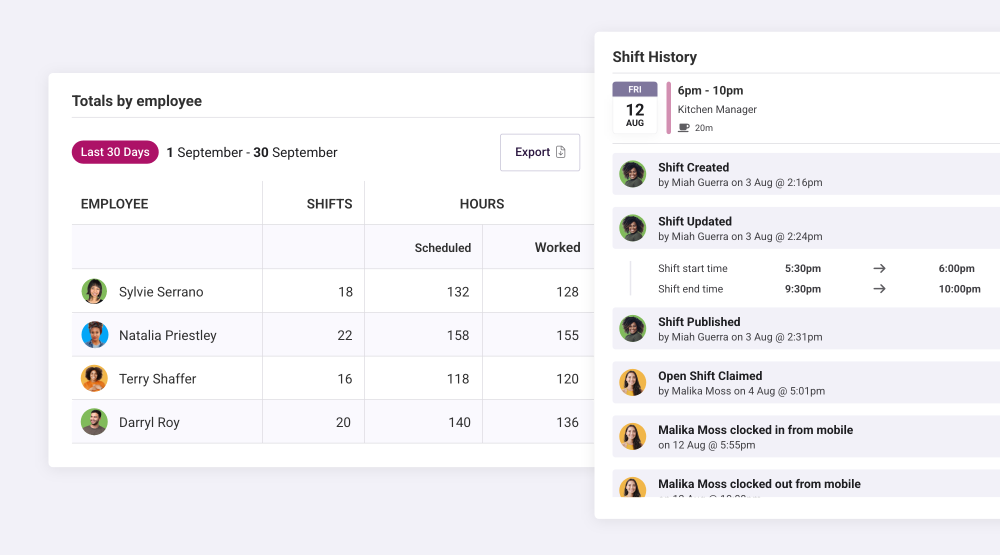
Weekly hours per employee, pullable for any reference period, so you can see who's trending toward a consistent pattern well before the obligation to offer a contract catches you off guard.
Notice and change tracking, built in.
Every shift, every change, every cancellation timestamped, your evidence if a claim ever lands, with none of the extra logging.
Less admin, not more.
The honest worry with new employment law is that it always means more admin. Done manually, it would. Run through Shiftie, and the compliance work happens as a byproduct of running your rota properly, not as a separate job bolted on top.
A return you can actually defend to your boss
Every hour a manager spends cross-referencing rotas by hand is an hour that costs you money and leaves room for error. One avoided tribunal claim, or one guaranteed-hours offer that didn't get missed, pays for the system many times over.
FAQs: Eployment Rights Act 2025 for Shift Employers
The government's current timetable has reasonable notice and guaranteed hours rules landing together in 2027, likely from January, though the exact commencement date is still to be confirmed by secondary legislation. Other pieces of legislation are already in place.
Early guidance suggests something around 72 hours, but the precise figure's still being ironed out; the government's consultation on the details closed in August 2026.
Anyone whose hours have settled into a consistent pattern over the expected 12-week reference period. They can decline and stay on zero-hours terms, but you'll need to make the offer again each reference period after that.
No, the changes add notice, compensation, and guaranteed-hours obligations around zero-hours and variable-hours work. They don't get rid of it.
Get Audit-Ready Before 2027
Know who's on flexible terms, know what they're actually working, and get a system in place that tracks it for you instead of relying on someone remembering. Get in touch with Shiftie to see how we can help you get ahead of the upcoming changes.
Quick disclaimer: this is a general guide, not legal advice. Several of the figures above are still being finalised through secondary legislation, so check the latest government guidance before making compliance decisions on the back of it.
Book A Free Demo